Stop Talking About Yourself: The Secret to Sharing Impact Without Bragging
Talking about your community impact doesn’t have to feel like self-promotion. The secret is surprisingly simple: stop making your company the hero and shift the focus from what you contributed to what it made possible—from contribution to consequence.


“We Don’t Want to Brag.”
It’s one of the most common things we hear from businesses doing incredible work in their communities.
They donate.
Their employees volunteer.
They sponsor local programs.
They support nonprofits doing meaningful work.
And then... they barely talk about any of it.
The instinct is understandable. Nobody wants their community investment to become a self-congratulatory marketing campaign.
Nobody wants a meaningful act of giving to be reduced to:
“Look at us. Look how generous we are.”
So companies stay humble.
They quietly do good.
And they assume the work should speak for itself.
There’s just one problem.
Work doesn’t speak. People do.
And when nobody tells the story, much of that good remains invisible.
The answer isn’t to start bragging.
It’s to tell a different kind of story.
The First SHIFT: Stop Talking About Yourself
That’s the idea behind the first mindset change in the SHIFT Framework:
S — Stop Talking About Yourself
Stop making your company the hero. Start highlighting the people whose lives were changed.
In other words, tell a different kind of story.
Your company still belongs in it. The shift is simply to move the focus from what you contributed to what it made possible—from contribution to consequence.
And that distinction matters, because avoiding self-promotion and staying invisible are not the same thing.
Humility Is Admirable. Invisibility Isn’t.
Wanting to avoid bragging is a good instinct.
In fact, research suggests organizations are right to be thoughtful about how they communicate their social impact. A 2020 study published in Corporate Social Responsibility and Environmental Management found that both inauthentic information and a self-promotional tone significantly increased consumer skepticism. How an organization communicates its impact can matter as much as what it communicates.
But somewhere along the way, many organizations have turned that legitimate concern into a false choice:
Talk about ourselves and risk sounding self-congratulatory.
Or:
Stay humble and say very little.
There’s a third option.
Tell the story. Just don’t make yourself the main character.
Because when good work stays invisible, the consequences extend well beyond whether your company gets recognition.
The nonprofit doing incredible work receives less recognition.
Employees may never see what their company’s investment actually accomplished.
Customers and community members may never discover an organization they could support.
Other businesses may never see an example that inspires them to act.
A volunteer may never discover their next opportunity.
A potential partner may never realize there is a problem they could help solve.
And the next donation, volunteer, advocate or idea may never materialize.
That’s why sharing community impact shouldn’t simply be viewed as promotion.
A good impact story doesn't simply tell people what happened. It can help something happen next.
As we shared in the original SHIFT Framework, visibility isn’t necessarily the end result of impact. It can be the beginning of more of it—helping employees engage, customers connect, partners advocate and others become inspired to participate.
So perhaps the better question isn’t:
“Will this look like bragging?”
Perhaps it’s:
“Whose story could become more visible if we share it well?”
And often, answering that question doesn’t require finding a different story. It simply requires changing who you put at the centre of it.
Change the Hero, Not the Story
Consider two ways of communicating exactly the same contribution.
VERSION 1
We’re proud to donate $5,000 to ABC Foundation.
There’s nothing inherently wrong with that statement.
It communicates the contribution.
But the company is clearly the main character.
Now consider another version:
VERSION 2
More young people in our community will soon have access to free mental-health support. ABC Foundation is expanding its program this fall, and we’re proud to help make that possible with a $5,000 contribution.
Same contribution.
Completely different story.
The first answers:
What did we do?
The second answers:
What happened because we did it?
That small change in perspective can completely change how a story feels. And notice: the company hasn’t disappeared from the second version. Its role has simply changed.
Don’t Remove Your Company From the Story. Change Its Role.
Stop Talking About Yourself is intentionally provocative.
We’re not suggesting your company should disappear from the story.
Your organization invested the money.
Your employees gave their time.
Your leadership made the decision.
Your company developed the partnership.
You should absolutely be part of the story.
But you don’t always need to be its hero.
Instead, your organization can be the:
supporter.
partner.
catalyst.
connector.
enabler.
The difference can be as simple as moving from:
“Look what we did.”
to:
“Look what we helped make possible.”
That isn’t minimizing your contribution.
It’s putting your contribution into context—and being clear about the role you actually played.
And, ironically, it may communicate your values much more powerfully than simply telling people how much you care.
So if your contribution provides the context rather than the story itself, what should you focus on instead?
From Contribution to Consequence
Start by changing the questions you ask when you find a potential story.
Instead of beginning with:
How much did we give?
Ask:
What became possible because of it?
Instead of:
How many employees volunteered?
Ask:
Who did they help?
Instead of:
What organization did we sponsor?
Ask:
What is that organization trying to change in our community?
Instead of:
How do we tell people what our company did?
Ask:
Whose story deserves to be told?
Think of it as moving from contribution to consequence.
Another way to think about it: move from inputs to outcomes.
Dollars donated, hours volunteered and sponsorships provided tell us what went in. Meals served, programs delivered and people reached tell us what happened. A strong impact story helps us understand what changed because of it.
What This Looks Like in Practice
Here’s another example.
Instead of:
Our employees volunteered 50 hours at the local food bank this month. We’re proud of our team for giving back!
Try:
The local food bank had a big job ahead: preparing hundreds of hampers for families across our community. Ten members of our team were fortunate to spend the day alongside their staff and volunteers, contributing 50 volunteer hours to help get those hampers ready and out the door.
The volunteer hours still matter.
You can absolutely include them.
But now the hours serve the story rather than becoming the story.
Or instead of:
We’re excited to sponsor the Community Youth Centre for another year.
Try:
Hundreds of young people in our community have a safe place to connect, learn and belong because of the work happening every day at the Community Youth Centre. We’re grateful to continue supporting their team for another year.
Notice something?
The company hasn’t disappeared.
Its support is still visible.
It just isn’t standing in front of the impact.
Which raises a fair question…
“But Shouldn’t We Get Some Credit?”
Yes.
This isn’t an argument against recognizing companies that invest in their communities.
Good corporate citizenship should be visible.
Employees should know what their company supports.
Customers should understand the values behind the organizations they choose.
Partners should be recognized for what they contribute.
And businesses should be able to demonstrate their commitments.
The mistake is assuming recognition requires being the hero.
It doesn’t.
There’s a meaningful difference between recognizing your contribution and making your contribution the story.
Your organization can say:
We supported this.
We’re proud to be part of it.
We believe this matters.
Those statements can coexist with a story centred on the people actually experiencing the impact.
Impact storytelling isn’t about taking yourself out of the story. It’s about putting the impact at the centre of it.
Try the Hero Check
Before you publish your next community-impact story, ask yourself:
- Who is the first person or organization we talk about?
- Is this primarily a story about what we gave—or what happened because of it?
- Would this still be an interesting story if our company name and logo disappeared?
- Have we given the nonprofit, community organization or people involved enough recognition?
- Will someone reading this understand why the story actually matters?
- Are we letting the people involved tell their story—or are we using their story to tell ours?
Two of those questions are especially revealing.
Would this still be an interesting story without our logo?
If the answer is yes, you’re probably telling an impact story.
If the answer is no, you may simply be writing an announcement.
And sometimes an announcement is exactly what you need.
Just don’t confuse the two.
And are we letting people tell their story—or simply using their story to tell ours?
The first tests whether you have an impact story.
The second tests whether you're telling it authentically.
Your Community Doesn’t Need More Corporate Bragging. It Needs More Good Stories.
Stories about the people solving problems.
The volunteers showing up.
The organizations strengthening communities.
The employees discovering causes they care about.
The programs creating opportunities.
The people whose circumstances changed.
And yes—the businesses helping make those things possible.
The goal isn’t to pretend your contribution didn’t matter.
It did.
The goal is to help people see beyond the contribution to what it actually made possible.
So the next time someone in your organization says:
“We don’t want to brag.”
Agree with them.
Then tell a different kind of story.
One that doesn't make your company the hero—but makes the impact impossible to miss.
The SHIFT
💡 Stop making your company the hero. Start highlighting the people whose lives were changed.
Move the focus from:
What did we contribute?
to:
What did our contribution make possible?
That one change in perspective can transform a corporate announcement into a human story.
Want a quick reminder?
We created a simple one-page guide to the full SHIFT Framework, with the five mindset changes and practical reminders to help keep your impact storytelling focused.
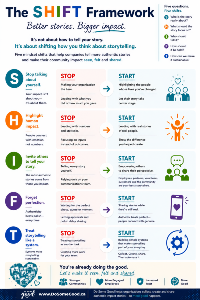
Next: H — Highlight Human Impact
Changing the hero is only the first step. Now we need to decide what part of their story is worth telling.
Even when companies put the community at the centre, they often tell the story through numbers:
Dollars donated.
Hours volunteered.
Meals served.
People reached.
Those numbers matter.
But they’re rarely what people remember.
So the next question is:
What should the story focus on?
In the next article in the SHIFT Series, we’ll unpack:
H — Highlight Human Impact
Why people feel stories more than statistics—and how to use both.
Make the Good You Do Seen, Felt and Shared
Do Some Good helps companies put these ideas into practice by making it easier to collect, create and share authentic impact stories—without adding more manual work for their teams.
By bringing community investment, employee engagement, story collection and content distribution together, companies can spend less time chasing stories and more time building relationships and creating impact.
Learn how Do Some Good can help your organization turn community impact into stories that inspire action.
Follow the SHIFT Series
This is the first of five deep dives into the mindset changes behind the SHIFT Framework.
Up next: H — Highlight Human Impact.
Subscribe to the Do Some Good blog and follow along as we unpack each SHIFT with practical ideas, examples and simple ways to put them into action.
About the Author
Jeff Hoffart is the COO of Do Some Good and is driven by a personal purpose to create exponential impact by empowering others to become catalysts for positive change.
A former teacher, TEDx organizer and best-selling author, Jeff has spent his career helping people and organizations turn ideas into meaningful action. Today, he works with businesses, nonprofits and community leaders to use technology, storytelling and connection to create greater impact at scale.
About Do Some Good
Do Some Good exists to help communities thrive by bringing people and organizations together to create impact, make it visible and inspire even more good.
Our platform helps companies simplify community investment, engage employees and collect authentic stories of impact—all in one place. By making it easier to manage giving, capture the difference it creates and share those stories across company channels and beyond, Do Some Good helps businesses spend less time on administration and more time creating meaningful community impact.