The SHIFT Framework: 5 Mindset Changes That Lead to Better Impact Stories
Your organization may be doing incredible work in the community—but are you telling the right stories about it? The SHIFT Framework explores five mindset changes that can make your impact stories more human, authentic and powerful.


Stop telling the wrong stories—and start making your community impact seen, felt and shared.
The Problem Isn’t Your Writing
Every day, companies invest money, time and talent into strengthening their communities.
Yet much of that impact is never truly seen, understood or felt—and when impact stays invisible, companies miss the opportunity to build trust, deepen engagement and inspire others to act.
Not because companies do not care.
Not because they are not making a difference.
And often, not because their stories are poorly written.
The bigger problem is that many companies begin with the wrong idea of what an impact story should be.
They make the company the hero.
They lead with dollars and volunteer hours.
They rely on the communications team to tell every story.
They polish meaningful moments until the emotion disappears.
And they treat storytelling as one more task competing for time.
After working with hundreds of companies over the past decade, we have learned that the strongest impact storytellers are not necessarily the companies doing the most.
They are the companies thinking differently about how stories are found, told and shared.
Most storytelling advice focuses on improving the writing.
But better words cannot fix a story that starts from the wrong perspective.
We believe the first step is changing the mindset.
That is why we created the SHIFT Framework: five connected changes that help companies tell more authentic stories and make their community impact seen, felt and shared.
Five questions. Five shifts.
The framework follows the natural progression every company should consider:
- Who is the story really about?
- What should the story focus on?
- Who should tell it?
- How should it be told?
- How can storytelling become sustainable?
The SHIFT Framework
S — Stop Talking About Yourself
Who is the story really about?
Stop making your company the hero. Start highlighting the people whose lives were changed.
One of the biggest storytelling mistakes companies make is assuming the story is about them.
It is not.
Your donation is not the story.
Your volunteer day is not the story.
Your sponsorship is not the story.
The story is the family that found support because of your donation.
The volunteer who discovered a new passion.
The nonprofit that expanded its reach.
The child who gained an opportunity they otherwise would not have had.
Your company played an important role. But being part of the story does not mean you need to be the hero of it.
People connect most deeply with other people. Let the individuals and organizations closest to the impact take centre stage.
H — Highlight Human Impact
What should the story focus on?
Stop leading with numbers and statistics. Start leading with emotion, people and outcomes.
Too many community-impact stories begin with numbers:
“We donated $50,000.”
“Our employees volunteered 800 hours.”
Those numbers matter. They demonstrate scale and commitment.
But they are rarely what people remember.
People remember names.
Faces.
Challenges.
Moments of kindness.
And the difference something made in a person’s life.
Start with the human story. Then use numbers to give it context and credibility.
Instead of only saying that employees volunteered 800 hours, show what those 800 hours made possible.
Who was helped?
What changed?
What did it mean to the people involved?
Then let the 800 hours demonstrate the scale of that impact.
I — Invite Others to Tell Your Story
Who should tell it?
Stop trying to create every story yourself. Start empowering others to share what they saw, felt and experienced.
One of the most authentic stories about your company probably will not come from your communications team.
It may come from:
- a nonprofit partner
- an employee
- a volunteer
- a customer
- a community leader
- someone directly affected by the initiative
These voices provide something company-written content often struggles to create: credible, third-party perspective.
There is an important difference between a company saying, “We make a difference in our community,” and a nonprofit partner, employee or community member showing how that difference was experienced.
One is a claim.
The other is social proof.
When someone else talks authentically about the role your company played, it does not feel like self-promotion.
It feels like proof.
This also reduces the pressure on one department to find and write every story. Instead of becoming the only storyteller, your communications team can help others recognize, capture and share meaningful moments.
F — Forget Perfection
How should the story be told?
Stop waiting for the perfect words, photo or moment. Start sharing stories while they are still real.
Many meaningful stories never get shared.
They wait for communications to review them.
Then marketing edits them.
Then legal approves them.
Then someone searches for a better photo.
Eventually, the emotion fades and the moment passes.
Polish can make a story look better. Authenticity is what makes people believe it.
A genuine photo taken on someone’s phone may tell a more believable story than a staged corporate image. A short reflection from an employee may feel more personal than a carefully constructed press release.
This does not mean quality, consent or accuracy should be ignored.
It means companies should not polish every trace of humanity out of their stories.
People do not expect every community story to look like a national advertising campaign.
They expect it to feel genuine.
T — Treat Storytelling Like a System
How can storytelling become sustainable?
Stop treating storytelling as another task. Start building it into the work you already do.
Perhaps the biggest misconception is that telling more stories must create more work.
It should not.
Sustainable storytelling is not about adding another item to your team’s to-do list. It is about creating simple, repeatable ways to capture the impact that is already happening.
The best time to collect an impact story is often not months later when someone remembers to ask for one. It is when the impact is already being created, experienced or reported.
Ask for a short reflection when a volunteer experience ends.
Collect stories, photos and testimonials as part of community-investment follow-up.
Invite nonprofit partners to share what your support helped make possible.
Encourage employees to capture moments that made them proud.
Create a process for approvals and consent before the story is needed.
Then use technology to help turn those moments into stories and distribute them across your website, social channels, newsletters, intranet and other communication tools.
Better Stories Create More Impact
Companies do not necessarily need to do more good.
They need to make more of the good they are already doing visible.
Because visibility is not the end result of impact. It can be the beginning of more of it.
When people see and feel authentic community impact:
Employees become more engaged.
Customers feel more connected.
Community partners become stronger advocates.
Trust grows.
And others are inspired to participate, volunteer, donate or support the causes involved.
That is the real purpose of impact storytelling.
Not simply to show the good your company has done.
To help that good grow.
Take the SHIFT Framework with You
That's a lot to absorb.
Rather than trying to remember everything, we've created a simple one-page version of the SHIFT Framework you can keep on your desk, share with your team, or use as a quick reminder the next time you're writing an impact story.
No email. No forms. No strings attached.
Just a free resource from our team to yours—because if it helps you tell better stories and inspire more good, that's what matters most.
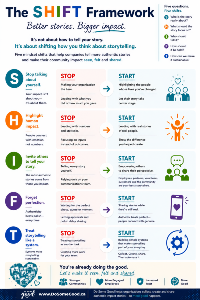
Make the Good You Do Seen, Felt and Shared
Do Some Good helps companies put these ideas into practice by making it easier to collect, create and share authentic impact stories—without adding more manual work for their teams.
By bringing community investment, employee engagement, story collection and content distribution together, companies can spend less time chasing stories and more time building relationships and creating impact.
Learn how Do Some Good can help your organization turn community impact into stories that inspire action.
Follow the SHIFT Series
This is just the beginning. In upcoming posts, we'll unpack each part of the SHIFT Framework with practical ideas and examples to help you put each mindset change into action.
About the Author
Jeff Hoffart is the COO of Do Some Good and is driven by a personal purpose to create exponential impact by empowering others to become catalysts for positive change.
A former teacher, TEDx organizer and best-selling author, Jeff has spent his career helping people and organizations turn ideas into meaningful action. Today, he works with businesses, nonprofits and community leaders to use technology, storytelling and connection to create greater impact at scale.
About Do Some Good
Do Some Good exists to help communities thrive by bringing people and organizations together to create impact, make it visible and inspire even more good.
Our platform helps companies simplify community investment, engage employees and collect authentic stories of impact—all in one place. By making it easier to manage giving, capture the difference it creates and share those stories across company channels and beyond, Do Some Good helps businesses spend less time on administration and more time creating meaningful community impact.